



How to Tell if a Tarantula is Male or Female (Complete Sexing Guide)
One of the most common questions asked by new keepers is how to tell if a tarantula is male or female. In most species, the two sexes look almost identical throughout the early stages of their lives, making identification difficult for beginners.
However, once a male tarantula reaches maturity, the differences become obvious. Understanding these differences is important for keepers because female tarantulas live significantly longer than males, often by many years.
If you’re interested in learning more about tarantula husbandry, enclosure setup, and species selection, see our complete Tarantula Care Guide and Natural History.
This article explains the key differences between male and female tarantulas and the most accurate methods used by experienced keepers to determine sex.
Why Tarantula Sex Matters
Knowing the sex of your tarantula can be important for several reasons.
Female tarantulas typically live much longer than males. In many species, females may live 15–30 years, while males often live only 1–5 years after maturity.
Because of this lifespan difference, females are often considered more desirable by hobbyists who want a long-term pet.
Sex also affects:
-
lifespan
-
breeding potential
-
adult size
-
physical appearance
However, determining sex in young tarantulas can be extremely challenging because juvenile males and females look nearly identical.
Identifying a Mature Male Tarantula
Once a male tarantula undergoes his ultimate molt (his final molt into adulthood), his body changes dramatically.
At this stage, several features appear that clearly identify him as a mature male.
Palpal Bulbs
The most obvious sign of a mature male is the presence of palpal bulbs, also known as emboli.
These structures appear at the tips of the pedipalps (the short appendages near the mouth). They resemble small boxing gloves and are used to transfer sperm to the female during mating.
Tibial Hooks (Tibial Spurs)
In many species, mature males also develop tibial hooks on the underside of the first pair of legs.
These hooks serve a specific purpose during mating. They allow the male to hold the female’s fangs away from his body while he transfers sperm.
These structures are commonly called:
-
tibial spurs
-
mating hooks
-
tibial apophysis
If you observe both palpal bulbs and tibial hooks, you are almost certainly looking at a mature male tarantula.
Body Shape Changes
Mature males also tend to look noticeably different in body structure.
Typical characteristics include:
-
slimmer abdomen
-
longer legs
-
lighter body weight
-
smaller overall body mass
Many keepers describe mature males as appearing “leggy” or delicate compared to females.
Some species even develop different colors or patterns after maturity.
Female Tarantulas
Female tarantulas maintain a heavier, more robust body structure throughout their lives.
They typically have:
-
thicker legs
-
broader carapace
-
larger abdomen
-
stronger chelicerae (fang-bearing mouthparts)
Females also continue molting throughout their lives, while mature males rarely molt again after reaching adulthood.
However, these physical differences can be subtle. Without experience or direct comparison between specimens, body shape alone is not always a reliable method of sexing tarantulas.
The Most Accurate Method: Examining a Tarantula Molt
The most reliable way to determine the sex of a tarantula is by examining the exuvium, or molted skin.
When a tarantula molts, it sheds its entire exoskeleton, including structures inside the abdomen.
If the tarantula is female, the molt will contain a structure called the spermathecae.
What is Spermathecae?
Spermathecae are internal organs used by female tarantulas to store sperm after mating.
These structures are located above the genital opening and between the front pair of book lungs.
If spermathecae are present, the tarantula is female.
If they are absent, the tarantula is male.
How Keepers Examine Tarantula Molts
To examine a molt properly, the abdominal skin must be softened and carefully unfolded.
This process typically involves:
-
Softening the molt in warm water
-
Carefully opening the abdomen section
-
Flattening the area around the genital opening
-
Inspecting the region between the anterior book lungs
Experienced keepers often use a stereo microscope, but in large adult tarantulas the spermathecae may be visible to the naked eye.
Because the exoskeleton can be fragile, patience and careful handling are essential.
Visual Ventral Sexing
Another method sometimes used by hobbyists is ventral sexing, which involves examining the underside of the abdomen.
By closely inspecting the epigastric furrow, experienced keepers may detect slight differences between males and females.
However, this method is not always reliable, particularly in:
-
spiderlings
-
small juveniles
-
species with thick abdominal hair
For this reason, molt examination remains the gold standard for sex determination.
Why Juvenile Tarantulas Are Difficult to Sex
Young tarantulas often show no visible sexual differences.
Before maturity:
-
males lack palpal bulbs
-
males lack tibial hooks
-
body proportions remain similar
Because of this, juvenile tarantulas are frequently sold as “unsexed” specimens.
Only after several molts, or after examining a molt, can their true sex be determined.
Final Thoughts
Learning how to tell if a tarantula is male or female is an important skill for any keeper. While mature males are often easy to identify thanks to their palpal bulbs and tibial hooks, younger spiders require more careful examination.
The most reliable method remains studying the tarantula’s molted exoskeleton for spermathecae, a structure only found in females.
Understanding these differences not only helps keepers plan for the lifespan of their tarantula, but also provides insight into the fascinating biology of these remarkable arachnids.
For more information on tarantula species, care, and enclosure setup, explore our full Tarantula Care Guide and Natural History.
Written by: Michael Jacob, 2008-2013
Illustration: Darby Cunningham, The Defiant Forest, Inc.
In most tarantula species, the female and male look almost identical throughout most of their lives. That is, until a male reaches maturity where he may look drastically different than he did prior to his maturing (or ultimate) molt. Since females live much longer than males, they are more desirable to the pet keeper. However, telling the two sexes apart can be very difficult, especially for the novice keeper. People soon learn to recognize the characteristics of a mature male, but it can be much harder to distinguish between an immature male and a female, especially in young tarantulas.
The Mature Male
When a male has his ultimate (final) molt and reaches sexual maturity he is a completely different spider. During this ultimate molting process, he obtained his sexual organs, which are bulbs (emboli, plural; embolus, singular) on the end of his pedipalps that are used to transfer sperm from his sperm web to the female. In many species males also have tibial spurs, which are "mating hooks" on the underside of the tibia (or long segment) of the first pair of walking legs and are used to engage the female's fangs during mating. These two structures, the tibial apophysis (or spur) and the embolus (or palpal bulb) are the things to look for to determine if you have a mature male. In some species the transformation is even more obvious, as mature males have distinctly different colors and patterns, and are much smaller and more thinly built and "leggy" than females.
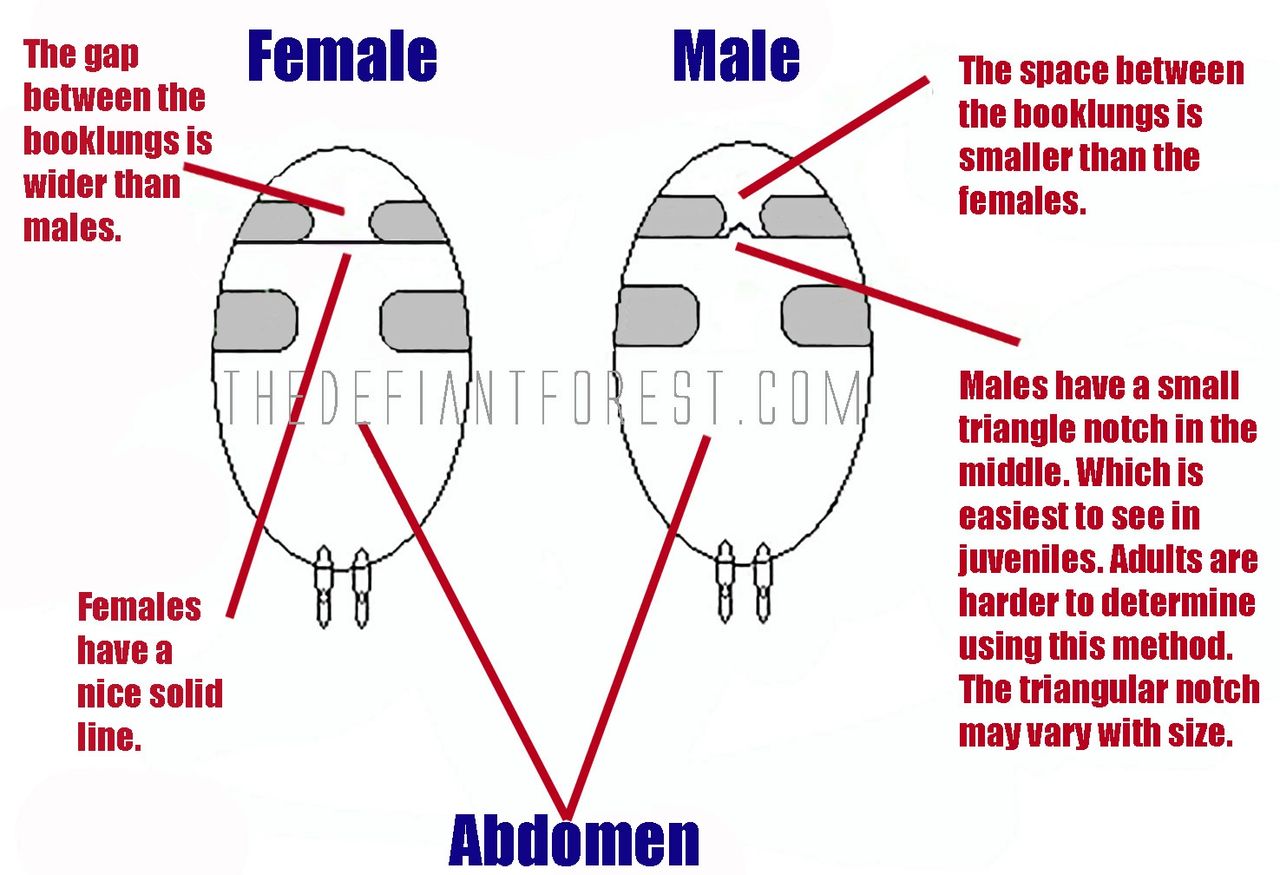
Although mature males may be obvious once you learn the characteristics, they often look very similar to the female prior to the ultimate molt. It is true that adult females are generally larger (often significantly so) and more heavily built than males, and that their chelicerae (the "jaws" that terminate in fangs at the front of the body) are proportionately broader. But these are subtle differences that require some experience to use and several specimens to compare. They can even fool the experienced keeper. Below we discuss the most accurate method of sex determination, the microscopic examination of molted specimen to detect the absence or presence of spermathecae only found in females. We also mention a good method of visually sexing tarantulas by careful examination of the epigastric furrow region on the underside of the abdomen [or opisthosoma] and link to an informative page on another site that details this method. Although it can be difficult to use this method reliably in young tarantulas, even novice keepers can often sex their adult tarantulas by careful study of the illustrations provided.
Examination of Molts
The most accurate method of determining the gender of a live tarantula is to examine the interior of the abdominal portion of its exuvium (molted skin or exoskeleton). A female tarantula sheds the spermathecae lining along with the rest of her exoskeleton and an experienced examiner can look for the presence of spermathecae, which is the sperm storage receptacle of the female. This usually requires the use of a stereo dissecting microscope with lighting above and below the stage, but spermathecae are visible to the naked eye with most skins of large adult tarantulas. Examining exuvia (molts) for the presence or absence of spermathecae requires experience, softening the skin, and carefully unfolding and untwisting the abdominal skin so that the four book lungs and the genital opening are stretched flat. Spermathecae lie above the genital opening [epigynum] between the anterior book lungs. The spermathecae are surrounded by the uterus externus. In some species, the males have accessory organs that can be mistaken for spermathecae by inexperienced examiners and carefully looking for the uterus externus is important.


